Showing posts with label Reggefiber. Show all posts

Monday, 6 September 2010

Free lesson: KPN Fiber receives a death blow and Reggefiber is left with the mess

If you work in telecoms, read this and learn. This happens if you don't pay attention to detail and just because this is an incumbent doesn't mean it won't happen at your FTTH project. Pay attention or it might cost you your FTTH-dream. 

KPN must have had one of the worst nights in a while tonight. Their fiber offer was on TV in Dutch consumer advocacy programme Tros Radar. The words consumer advocacy say enough: Guilty and no way of proving yourself innocent on TV. The piece was lacking in some technical areas, but was damning in many others. The most damning, hidden camera footage of an actual purchase and install. Some of the claims:

  1. Fiber isn't always fiber. It's often VDSL2 where the fiber end only goes as far as the start of the neighbourhood. Fair enough, UPC does the same with Fiber Power (Docsis 3.0). But still, people claim they are cheated and the name "KPN Fiber" has now been tainted. 
  2. KPN's sales and billing are completely detached. People are told they will pay 65 Euro a month for the whole package and then find additional costs on the bill. Sales for instance promises a third IP-TV decoder, for which they are charged extra, just to get the sale. Customer service can then mop it up, but doesn't seem to be able to fix things straight away. 
  3. The technician who installs the technology in the home will do it all for a fee of 35 payable to the technician. THIS IS A NO NO. NEVER ALLOW THIS ON YOUR PROJECT. The technician quickly turned it into an extortion racket, a complete con job. He just claims that several things are not on his job list, like the third decoder. Also he says there is no electricity near the fiber drop (in The Netherlands the meter closet) and that that is extra. Everything that isn't on his list is some number at KPN and he can do it for half. Yeah yeah, so pretty soon the charges add up and he walks out with alot more and KPN doesn't need to know about it. Nice huh how people who work for you can F your product. I'm betting as of next week installation is free and KPN doesn't allow any money to be charged at all. The free bit is only because fixing the billing system to work with a 35 euro charge is more expensive than just giving installation away for free. 
  4. KPN uses a product it calls wireless to deliver the IPTV in the home. Of course it isn't wireless, it's actually some version of Powerline communications, probably Homeplug (I didn't Google it). Branded with KPN's logo, it doesn't actually perform as expected. Speeds are low. It isn't really wireless and brings unsightly plugs in the home. The nasty thing is that sales pushes it hard... probably to shift inventory and customer service tells people it is a lousy product. Yes, that's right KPN customer service knows its a rotten product and tells its customers so. 
  5. KPN's IP-TV service mine is shown on TV as malfunctioning. It doesn't do HD-TV at one customer and at an other the pause function is malfunctioning. It's not a nice picture. My wife asked me if it didn't do the same at our home, but that happened to be the DVB-T service of KPN called Digitenne. However, you can get the idea, if my wife thinks TV over FTTH is the same as DVB-T quality wise... than you're in deep trouble. 
  6. Other problems have to do with the entire delivery process. There was a customer whose telephone line couldn't be found, probably for VDSL. There was a customer who found out on delivery that the price was different as quoted. There was one who thought he would get HD-TV in the cheapest pack and didn't get it. 
  7. 1200 KPN Fiber customers were interviewed. 47% reported speeds weren't as promised. No explanation, probably because of the use of Wifi that speeds aren't up to snuff.. but try to explain that to a consumer. 
Now as said at the start, in this programme, you're guilty. Not even until proven innocent. They'll have a talking head lawyer tell you that this is against the law etc etc.They'll have the socially inept discuss your product. They have someone who "works in IT".  They'll tell people KPN uses coaxial cable into the home, whereas that's not the case of course. They won't look at the normal marketing material, which contains the caveats. They won't talk to people who are happy with what they got. But it doesn't matter. KPN messed up big time and it should have known it's too easy and too big a target not to shoot at. It's like painting a big bulls eye at the face of the CEO and then handing out pies at an amusement park. 

That said, KPN's partner Reggefiber, who installs the Glashart network KPN uses and pays for it out of its own pocket, must be fuming. The way to mess up a billion euro project like Reggefiber's is to have untrustworthy partners. Instead of the likely thing to happen, that one of it's minor service providers, like Solcon, Lijbrandt, Tweak, Concepts or one of the other one's messes up, it's the big one. The one that is known to every one in the country and it takes everyone with them. KPN paid for a 41% share and caused almost as much damage. 

Friday, 12 February 2010

Google FTTH: Lessons to be learned from Europe

(Update 14-2-2010, Google isn't planning to offer voice or video according to Minnie Ingersol of Google) Google is going to offer 1 Gbps FTTH. Most of you know that so I won't spend too much time on it. What I want to focus on is what Google can learn from FTTH projects in the EU.

Where should they locate their test site
The towns with the highest penetration on roll out seem to be smaller, more tight knit communities. Smaller towns, up to 10.000 families, in The Netherlands have been more successful in organizing their town to deliver the 40% minimal sign up before Reggefiber would enter the town. The town of Nuenen in the Netherlands reached and FTTH penetration of over 90% in the first year, but that was by giving the service away for free in the future.

When it comes Fiber to the Business/Institute, I've noticed that a region of smaller and larger towns that are at not too big a distance of eachother, are best for creating local cooperation. Municipal governments, SME's, schools all benefit from cooperation with similar organisations who are located in another town. Somehow this cooperation doesn't work that well within just one town. I don't really know why, but it might be that the organisations in different towns are different enough to allow for innovative ideas to flow. Whereas the ones in one town are all of a similar gene pool and that just leads to inbreeding.

Conclusion: Choose an area with 5-20 towns with roughly 100.000-200.000 homes. 

How should they promote their offer

What we have learned here in The Netherlands is that small and very local promotion works best. On New Years Eve, the people of FTTH-provider XMS were handing out free warm chocolate milk at one of the places where fireworks were sold. (They should have stood next to the cart selling "oliebollen", Dutch New Years Eve donuts. I stood in line for 1 hour) In Nuenen and Zeewolde people received a plant pin they could put in their front yard to signify that they had signed up. Nuenen worked together with local organisations, like the soccer club, which is often the focal point of the local community. In the US, it might be working with High School Football teams.Local Radio and Television are also good allies to have. They might also benefit from the network, being able to put HD video on the net for local consumption 

What also helps is to have a local shop/office where people can come, receive a demonstration, receive support and where they can be informed. Centrally located in a mall or in the city center is probably best. In Almere we now have Glashart shops. Here KPN and XMS present themselves to their prospective customers.

How to perform the installation
I really suggest Google gets on the phone with Schuuring here in The Netherlands. Their Fiber4All business is the one that installed the fiber into my home. One of the things I learned from them when I received a tour from their director was that it is important to have all the representatives of all the civil works and installation companies in the same building. When something went wrong the various sub-contractors were only a knock on the door away from the project-manager and each other.

What they also taught their personnel is to photograph anything that may lead to a possible complaint of the customer, telling the customer they had done so and writing a form to have it fixed. There is a lot of potential to break stuff. Staff with the right personal skills training can really make and break an install.

What to offer
I really, really hope Google doesn't just offer 1Gbit/s and that's all. I hope they aim to offer a triple play package in line with my article on the greatest ISP in the World. Integrated Google Voice is a minimum, but some other options I would like to see Google offer are:

  • Integrated shared Wifi-N. Imagine being able to roam authenticated(!) with your laptop/iPad/wifi device through town hopping on and off peoples wifi access point. This can be done in a way that is completely secure for the network you're roaming on.
  • Integrated 2G/3G/4G Picocells: This is an option, but imagine Google would integrate picocells and then either lease them out to Sprint, T-Mobile, Verizon and AT&T or allow people to configure them to their network of choice. Better coverage for all hopefully
  • A Digital Video Recorder/Home box that mimics the functionality provided by the Freebox of Free.fr. Even better, Google should just call Xavier Niel and ask how much of the tech in his network they can copy to the United States. Why invent a wheel and Free.fr is based alot on open source, so Google should be able to work with it. My good friend Tad does say that a different remote should be used as the one Free provides is of dubious build quality.
Some other things Google could help out with are offers to for instance the local sports teams to have some digital camera's next to the field for real time streaming and later viewing  for training purposes. I know some Dutch field hockey teams at amateur level are using Youtube already to store their training movies. They  are looking into how to have online streaming access to their games and practice sessions, both for promotion and for training purposes.

Other practical things
Please Google get the pricing right. A maximum of 50 dollars should be enough for a full triple play package. Also get a good helpdesk. Have a local helpdesk with local people who are proud of working for Google. (Give them a Google Nexus One to start with) Make sure these people actively read online support forums and proactively engage with customers who are complaining online. Image is everything.

Financing
I haven't heard anyone on the financing of this project, but it seems that this could all be pretty much self financing for Google. If done right the network can be sold with all the customers in ten years. Given an average sale price of 1000 dollars per sub for many networks, Google should be able to recover all it's investment in the network.   

Thursday, 21 January 2010

Confession of an FTTH-geek: I chose cable over FTTH

(don't forget to take the poll, to tell me what you would have done)
You've seen it in recent posts already. I switched to UPC. That really means that all despite all the FTTH pictures on my blog, I'm not actively connected to the internet over fiber at all. This has been tough for me to swallow. I really wish I could have done it differently. But business is business even if there is some emotion to it.

So why did I choose UPC Fiber Power 60 in december? Well, KPN made me do it. I wanted FTTH so much, I waited for 6 months to switch to UPC, even though I had already concluded it was the sensible thing to do. I just thought that KPN would get its act together. Then came the investors call of December 15. For me as a consumer, it wasn't good. All KPN could promise was, we're working on it. No timelines, no debate on how they would fix half year backlog and worse somewhere in the second quarter KPN would offer symmetrical speeds over fibre, but still at a too high price point.

So here I am, I chose UPC Fiber 60, because I get 60mbit/s that performs reasonably well and beats Alice DSL 6 times. I have the international calling package, which saves me from bill shock whenever we call in Europe, can't get that from KPN. I have the Royal digital TV package with a year free Film 1 movie channel, including a 100 movies on download. Can't get such a package from KPN. And the best thing is. It worked within 24 hours of walking into a UPC store, with minimal fuzz. All that for 25 less then what I would pay KPN and 5 less than what I paid Alice+UPC combined.

It's the economy.

Hopefully next year December XMS will have crossed the canal between Almere Buiten and my home and they serve my area as well. They offer 50mbit/s symmetrical at a reasonable price, but their phone offer is quite bad. I can't move away from UPC any time soon for the content as my wife likes it too much.. So all in all anybody who can offer symmetrical internet and international calling for 50 euro is my friend.

Wednesday, 24 June 2009

Fiber to my Home, the installation in home

Today fiber was installed in my home. You've seen the previous installments how fiber was just outside my front door. Today the last meter was bridged. This was done by a company called Schuuring. They apparantely are looking for more people to help out.  Two people came. One made sure that the fiber got from the front door to the utilities closet. The second guy did the final work, make the fiber ready for use.

The first guy
He started with opening the latch to the area between the floor and the ground, there is some space there to crouch. After this he opened up the stones in the street and dug a small hole to get the slack fiber from under the pavement. 


From Fibre to my Home
There is about 10m slack available
From Fibre to my Home

A hole is drilled in the outside wall to bring the fiber in. The fiber is run through and the hole is filled with some kind of elastic glue.

From Fibre to my Home
The slack is fed into the crouching space and left there. The last two meter is pushed upwards into the utilities closet.

From Fibre to my Home

The first guy is then almost finished. He cleans up after himself, hammers the stones back in. Tells the second guy that he has chipped a stone and promises that it will be replaced. His final task is to leave a plastic bag with a connection set for the second guy. Good thing to know. If the first guy doesn't hammer the stones back in properly and I would complain later on, than he has to come back on his own dime and fix the problem. So he was committed to hammering the stones back into the pavement the right way. (In 5 years time those stones will hover above the rest of the pavement I expect :-) )All in all this took about 15-20 minutes.

From Fibre to my Home

The second guy
The second guy came about half an hour later. He told me that they had been told not to allow pictures as some of the stuff was proprietary and "copyrighted". He was a young guy and I don't want to bring him into trouble. It seems Arcadis checks up on their work and well. Arcadis developed an online model for the Ministery of Economic Affairs which you can use to calculate the costs of installing a fiber network in The Netherlands. I used it for the calculations in my OECD paper.

I did get some pictures of his kit and the way the fiber was installed. The install itself takes less then 15 minutes and is mostly aimed at getting various layers of the fibers and then connecting the fiber to the connectors (which come with fiber attached). That then is put into the metering closet in the grey cabinet.
From Fibre to my Home


From Fibre to my Home
The splicer! Very cool with a small LCD screen.
From Fibre to my Home
The whole shebang installed in my utility closet. Next to it you can see my Alice DSL modem.

From Fibre to my Home
The Finished product.

The guy gave me some interesting information as well. An installer is required to do 11 installs per day. Homes like mine are easy. and they can do 20 of them on a good day. High Rise is difficult and takes more time. Older homes are also a pain. they sometimes need to drill straight from outside into the living room. A max of 6db signal loss is allowed. They try to do alot less, between 1 and 3. All in all the installation took only 15 minutes.

The line also needed to be tested. For this he used a unit by Kingfisher, pretty standard. What took the most time was getting someone on the phone at the central office. Those guys need to connect about 200 homes per day and they can be quite busy. There are 2 guys per central office. If someone finds a way in which the central office testing can be automated, that would be a great benefit. In my opinion. If you can get a testing unit to which you can hook up 500 to a thousand homes and have it communicate with the testing unit (or wirelessly to the guys mobile phone) that would be a major improvement to their workflow. Anything around 5 to 10 thousand euro would probably be worth the investment.

All in all this bit took another 15 minutes. 10 minutes for the waiting 5 for the testing.

Now I need to wait for KPN or Online to come up with a symmetrical offer for broadband to my home. Or shall I punish KPN and go for UPC for one year??

Bonus pictures
A picture of how Reggefiber promotes that people have signed up for fiber (glasvezel) in Zeewolde.
From Fibre to my Home

And some pictures of someone sitting in a tent in the street hooking up the fibers from individual homes to the main duct.
From Fibre to my Home

Thursday, 30 April 2009

FTTH: some more pictures of phase 1

Phase 1 is getting fiber to my home and that is now finished. Phase 2 will be hooking me and the rest of the street up to the active equipment. It took a bit longer for me to be hooked up to the network than I expected. I live almost precisely half way the street. The neighbours a couple of doors away to the right see their fibre go to the right. I see my fibre move to the left. The fibres meet up at the other end of the block.

At the end of the day a man from a construction company arrived to fix a damaged muff that encapsulated a traditional PSTN-cable. The man repairing it wasn't too kind about the competences of the fiber diggers. He said he had seen them too often and knew every dig site. At this moment only a small bit of fiber sticksout of the ground near my front door. It still needs to go to my meter closet, where the connections for the telephone, cable, electricty, cold water, warm water and central heating are too. (Almere has a city wide central heating and warm water system.)

From Fibre to my Home

From Fibre to my Home

From Fibre to my Home

From Fibre to my Home

Breaking the traditional world

From Fibre to my Home

From Fibre to my Home

From Fibre to my Home


From Fibre to my Home

Finishing the FTTH-build

From Fibre to my Home

nobody will ever read this... so it can be upside down

From Fibre to my Home

From Fibre to my Home

Wednesday, 22 April 2009

Reggefiber to my Home

Reggefiber has reached my home (almost) with their fiber. They are now two doors away from my home, so I expect not to be able to park my car on my own driveway this afternoon. This is part of what is locally known as Almeernet. KPN is currently offering services over it and Online (Deutsche Telekom) will soon too.

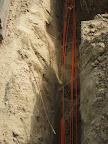
I made some pictures yesterday in my street and the neighbouring street. For those not familiar with Almere, The Netherlands. The town was build in what used to be a sea and later on a lake. Like most of The Netherlands the ground consists of clay and sand. Fiber is dug and installed with direct burial. The way Reggefiber goes about the installation is that first they dig the fiber in the street and run it through the front door. 3-4 weeks later someone comes to bring the fiber from the front door to the utilities closet, which most Dutch homes have.

The way they get fiber to the front door is the more interesting bit. It doesn't require digging. Because the soil is so loose, they can use a device (I call it a thumper), that drills itself under the driveway to the front door. This device is operated by compressed air. After this a duct is run from the street to the front door, through which fibre is run.

Enjoy the pictures. I hope I can make some of the installation in house too. In the Picasa webalbum there are some more that I took earlier.

From Fibre to my Home

From Fibre to my Home

From Fibre to my Home

From Fibre to my Home

From Fibre to my Home

From Fibre to my Home

From Fibre to my Home

From Fibre to my Home

From Fibre to my Home

From Fibre to my Home

From Fibre to my Home

Friday, 10 April 2009

UPC Fiber Power triumphant over KPN FTTH

I'm living in Almere. It's one of the first towns in the Netherlands that gets both FTTH from KPN/Reggefiber as well as UPC's Docsis 3.0 offer Fiber Power. I thought it would be good to compare the offers.

Conclusion
KPN's offer is disapointing. It doesn't give a revolutionary feel. This is not the thing you'll be bragging to the neighbours about.There is no compelling reason to upgrade fiber to from DSL and there is no compelling reason to switch away from UPC.

So KPN's got fiber. Internet isn't symmetrical, the TV offer doesn't have HDTV. KPN's TV offer offers too little channels, too little extra's. None of its offers have anything remotely innovative in them. It's clear KPN regards FTTH as nothing more than a more expensive upgrade from DSL. KPN can't even claim to offer the fastest internet in the country as UPC clearly gets that title. KPN strategy may have made a brilliant move with teaming up with Reggefiber, KPN Marketing sure knows how to mess it all up.

The price of the KPN's silver 50/5 offer at €80 is a bit more friendly than UPC's 60/6 offer at €92,60, but it doesn't offer the same quality TV. KPNs 60/6 offer at €110 is overpriced even if we allow for the Dutch Football League TV-channels.

Kudo's to UPC. It's technology is not up to the level of KPN's. It's expensive, it cheats on its website with only mentioning a €16 charge in the small print, but from personal experience I can say I like it's Royaal digital TV offer and according to the users on this forum its internet offer works as promised.

So what am I going to do? Well, I can't do without the BBC and KPN still can't offer it despite political pressure from the Netherlands on auntie Beeb and a lawsuit in the courts. (UPDATE 14-4-09: It's not KPN's fault that they can't offer BBC. The BBC is to blame here. I do fault KPN for not making the rest of the TV and internet offer better) I like the extra TV series that the Royaal offer has and I can't give my wife less than she currently has. So KPN is out for TV.

I would like to choose KPN's fibre offer. I'm currently on Alice DSL (20mbit/1mbit) and that delivers too little 6mbps with too much hassle (3 times major administrative problems). Moving to KPN for internet and telephony would give me the internet and telephony offer I had before. However at 55 euro and 30 euro for UPC royaal that would bring me to 85 euro a month. Almost as much as UPC fibre Power 60/6 at €92.

What needs to improve
Well call/mail me/twitter me, maybe we can do a strategy session. It is KPN however who is in the hot seat. It needs to create a wow factor for its offer. KPN can up the ante for free by making internet symmetrical. This might have some effects somewhere in its network, but it wouldn't change any of its wholesale transit agreements. KPN could also add a lot more television channels to its offer.It's the one who isn't constrained by technology, so add more analogue and more IP-TV channels. There should be a lot of more free to air channels available.

However if both KPN and UPC are continuing on this level, than price competition is their only option. What we need is innovation. New services on the network. Not that these are going to bring in massive amounts of money, but at this moment there is no compelling reason to switch between the two networks and worse for UPC customers there is no compelling reason to switch to KPN. Both networks could leverage their mobile offer and just add a lot more generic services to make their offer more sticky.

One final thought for KPN, in FTTH penetration is key to your businesscase, not ARPU. I can't fathom what the line of thinking was to market FTTH as DSL, but at 1000 euro per customer in investment, it can't be a good thing that Telfort or Planet DSL still looks like a compelling offer!

Methodology
All offers compared based on what I can find on the web.
Unfortunately KPN isn't too open about its offer. It requires one to find out where they offer their services, take a random postal code and see if your lucky. When you are lucky, this page contains a lot of information. For UPC I used the publicly available data.

KPN Glasvezel

The offers


This seems to be the whole service offer. You can have:
  • Telephony (unlimited national) and basic TV (40 channels) for €45
  • Internet 3/30 and telephony (unlimited national) for €55
  • Bronze package: Internet 3/30, basic TV (40 channels) and telephony (unlimited national) for €65
  • Silver package: Internet 5/50, TV (70 channels) and telephony (unlimited national) for €80
  • Gold package: Internet 5/50, TV (100 channels) and telephony (unlimited national) for €110
One thing strikes me straight away. The internet offer is styled like a DSL offer. It's asymmetric. KPN invested in P2P Ethernet 100mbit/s up and down, but it doesn't offer it here. Instead it offers fibre like it is some kind of DSL on steroids. There is no internet only package.

Technology

KPN's fibre terminates on a network termination box that converts the signal to ethernet (internet and interactive TV/IPTV) and to Coax (analogueTV). To the Ethernet box KPN connects its Experia box a home broadband router with 4 ports ethernet, wifi and connections for 2 telephones. The choice to deliver analogue tv is very interesting as this allows KPN to offer exactly the same usability/look and feel as the cable companies can. One of the major benefits in cable/analogue tv happy Netherlands is that all tv's in the house can receive the analogue signal without the need for extra IP-tv boxes. KPN offers the Motorola 1960 as its IP-TV convertor. It has a hard disk DVR, HDMI and can deliver HDTV.

The television offer
The basic offer is 40 channels analogue tv. This is available over coaxial cable to all tv's in the home and is included in all TV packages. All the channels Dutch people expect from analogue TV are included, like discovery, nat geo, cartoons, MTV, Belgian, German, French, Italian and Turkish channels, except BBC1 and 2.

The digital Bronze TV offer is similar, but with more regional channels and Playboy TV it can be expanded with the plus pack at €7,50. The Silver package adds the plus pack to the mix a lot more digital channels to the mix. The Gold package adds the Dutch football league to the package (normally 10 euro's). All digital TV offers come with "Programma Gemist", the Dutch version of iPlayer and a Video on Demand service that promisses 1000 movies.

I couldn't find any HD-TV channels on offer, which is weird. The Motorola box should be able to carry HD-TV channels.

Telephony
KPN employs a VoIP platform for its telephony over broadband and this is used here as well. Not very surprising and from personal experience I can say that it works quite well. Free national calling to fixed lines is included. Calling to mobile phones is 17 cents per minute with a 5 cent starting tariff. Calling to neighbouring countries, US, UK is 5 cents per minute. Rest of Europe and Australia and New Zealand is 10 cents. (Interesting, the bronze package of VDSL charges 3,5 cents per minute during the week and is free during the weekend.) A second line is €2,50 per month.


UPC Fibre power
The offers
Important! UPC charges an extra €16,70 as a standard fee for its basic TV-offer. There is no way to get around this charge. Add this to all prices!


UPC's fibre power offer is:
  • 60mbit/s down and 6 mbit/s up for €60,50
  • 120mbit/s down and 10mbit/s up for €80,50
  • the 25mbit/s down and 2.5 mbit/s up offer for €50,50 is comparable to KPN's bronze offer in speed, except that it seems that this one will be replaced by the 60/6 offer. Existing customers get the possibility to switch at no cost.

UPC has a proposition where the cheapest element in a triple play package is free. In general this is the Royaal digital TV offer of €13,50 with DVR. It does seem that UPC delivers the promissed speeds.

Technology
The modem is the Cisco EPC 3000.It is a Docsis 3.0 modem and doesn't offer any other functionality, like VoIP or digital TV. In order for it to function correctly installation by a technician is required, as it is very sensitive to signal quality. For telephony a customer will receive a standard Docsis modem, because it seems there are no Docsis 3.0 modems available with integrated VoIP. An end user will therefore receive 2 modems.

Television
Analogue TV is the basis of UPC's offer, it has the 30+ standard channels, including BBC 1 and 2. The digital offer is divided into two options starter and "royaal". The starter pack adds mostly regional channels. The royaal offer adds 40-50 channels including BBC 3 and 4. Next to television channels, there is also a Video on Demand offer available. This includes Programma Gemist (the Dutch iPlayer) and in the royaal offer a lot of on-demand tv-series available for free. (Frasier, dr. Who and Bob the Builder are among them). A DVR can be ordered for an additional €4-5,50 per month. There are more packages to choose from, like specific packages for specific nationalities, or sports (Dutch Football league) and movie channels. HDTV is an extra 9 euros

We're currently using the Royaal with DVR at home and we like it a lot.

Telephony
UPC's telephony offer is similar to KPN's. They have unlimited calling for €15,50 to national numbers. Calling to mobile is 17 cents and 10 cents starting tariff. International calls start at 5 cents, but seem to be a bit more expensive than KPN's offer. (often 1 cent per minute) An extra line is €7,50 per month.

Two afterthoughts
  1. I'm never going to write a review like this anymore... too exhausting to correctly describe everything in a triple play offer.
  2. I had a look at KPN's VDSL offer. It's even more disapointing.